Hiking - Around Mont Touleur
Deep in the forest, discover the Fréchots camp, a key site of the Morvan Resistance during the Second World War.
Larochemillay, yesterday and today
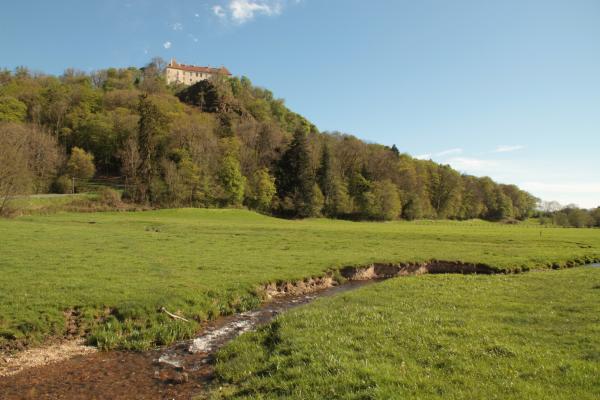
Dominating the Roman road linking Bibracte to the Loire Valley, this granite rock perched about a hundred meters above the Roche Valley was occupied since Antiquity by a Gallo-Roman oppidum (like Mont Touleur). Its strategic position gave it its name: Rupes militis (the soldier's rock). This picturesque village, one of the few in Morvan to have retained its medieval structure, lines its narrow streets with old houses from the 15th and 16th centuries. A castle, with very ancient origins, crowns the summit of the rocky spur.
Freed by their lord in the 13th century, thus becoming "burghers," the Millirupétiens obtained permission in the 15th century to build a fortified enclosure. A turret, adjacent to the village café, still remains. The commune was to become the most important in the canton.
During the jazz festival, which takes place in May, the village recaptures its past economic splendor. In the 1950s, the village still boasted a good fifty artisans and shopkeepers. The villagers take pride in decorating the facades and storefronts of their houses to recall the era when each housed a shop or an artisan's workshop. Not to mention the many cafes and inns. The "Tools and Traditions" museum on the church square invites you to discover over 3000 tools and folk art objects.
Larochemillay, yesterday and today
Dominating the Roman road linking Bibracte to the Loire Valley, this granite rock perched about a hundred meters above the Roche Valley was occupied since Antiquity by a Gallo-Roman oppidum (like Mont Touleur). Its strategic position gave it its name: Rupes militis (the soldier's rock). This picturesque village, one of the few in Morvan to have retained its medieval structure, lines its narrow streets with old houses from the 15th and 16th centuries. A castle, with very ancient origins, crowns the summit of the rocky spur.
Freed by their lord in the 13th century, thus becoming "burghers," the Millirupétiens obtained permission in the 15th century to build a fortified enclosure. A turret, adjacent to the village café, still remains. The commune was to become the most important in the canton.
During the jazz festival, which takes place in May, the village recaptures its past economic splendor. In the 1950s, the village still boasted a good fifty artisans and shopkeepers. The villagers take pride in decorating the facades and storefronts of their houses to recall the era when each housed a shop or an artisan's workshop. Not to mention the many cafes and inns. The "Tools and Traditions" museum on the church square invites you to discover over 3000 tools and folk art objects.