Hiking - Cure Valley Loop
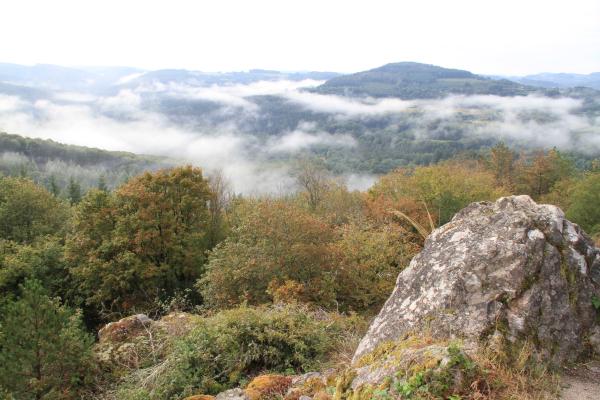
This loop follows the right bank of the Cure and passes by the Rocher de la Pérouse, which offers a wide panoramic view of the Morvan.
The Cure Valley, the landscapes around Rocher de la Pérouse.
Water in the Morvan
Springs, ponds, wet meadows, peat bogs, brooks, streams, rivers, canals, ponds and lakes... water is omnipresent in the Morvan and surfaces due to an impermeable granite bedrock (unlike the deep aquifers of limestone soils) and abundant rainfall. Therefore, water supply for agriculture and livestock was not a major problem there, which facilitated the dispersion of human settlements. It has always been used by humans for timber floating, mills, fishing... Today, it promotes tourism, electricity production, and agriculture. The rivers primarily feed
the Seine basin — 14% of the Seine's water in Paris originates from the Morvan — and to a lesser extent, the Loire basin. Thus, certain water reservoirs in the Morvan, particularly the large lakes, contribute to regulating the Seine's flow, preventing droughts or floods in the capital. Water resources are one of the major challenges of the 21st century. Therefore, the Park carries out significant work in research, monitoring, and safeguarding the quality of water and aquatic environments, without hindering certain sporting or tourist activities such as fishing, canoe-kayaking, rafting...
The Cure Valley, the landscapes around Rocher de la Pérouse.
Water in the Morvan
Springs, ponds, wet meadows, peat bogs, brooks, streams, rivers, canals, ponds and lakes... water is omnipresent in the Morvan and surfaces due to an impermeable granite bedrock (unlike the deep aquifers of limestone soils) and abundant rainfall. Therefore, water supply for agriculture and livestock was not a major problem there, which facilitated the dispersion of human settlements. It has always been used by humans for timber floating, mills, fishing... Today, it promotes tourism, electricity production, and agriculture. The rivers primarily feed
the Seine basin — 14% of the Seine's water in Paris originates from the Morvan — and to a lesser extent, the Loire basin. Thus, certain water reservoirs in the Morvan, particularly the large lakes, contribute to regulating the Seine's flow, preventing droughts or floods in the capital. Water resources are one of the major challenges of the 21st century. Therefore, the Park carries out significant work in research, monitoring, and safeguarding the quality of water and aquatic environments, without hindering certain sporting or tourist activities such as fishing, canoe-kayaking, rafting...