Hiking - Circuit de la Semène - Saint-Genest Malifaux n° 4
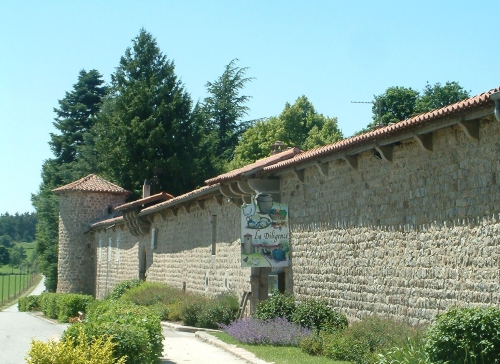
Discover the Circuit de la Semène and its superb landscapes of the Monts du Velay.
Louis Michel Courbon, Baron of Saint-Genest, and his wife Amédée de Saint-Didier, first lived in the family home located in the middle of the village (the current town hall), adjacent to a large park planted with ash and sycamore trees, which gave its name to the Rue du Feuillage.
The Château de Pérusel was built by this family in 1856. Tradition has it that Baroness Amédée de Saint-Didier traced the boundaries of the future home on the ground with the tip of her parasol. Attached to the Château de Pérusel was a chapel that was used as a burial place, and Amédée de Saint-Didier was the last person to be buried there in 1921.
This site was occupied during the last war by the Germans and then the FFI, and was sold in 1952.
Until 2011, the château housed a specialised school.
Today, it is private property.
Follow trail n°1 to the Croix Verte; there, go down to the right and then take the path to the left. You will see the Château de Pérusel. After 500 m, leave the paved road and head straight onto the forest track for 2 km to reach the D501.
Detour: before crossing, a visit is a must: “la Font Ria,” a spring that gushes out between several engraved stones. Follow the D501 to the Croix de Trêve.
There, go down the Route de la Ricamarie for 150 m, take a path on the left and continue along the descending path. After 300 m in the hollow,
go down a few metres to the right; the spring is there.
Retrace your steps. Cross the road to take the path that goes deep into the woods. When you reach
the crossroads, turn left, go 100 m and then turn right onto a stony path at the edge of the woods, which descends towards la Célarière. You will reach the D37; follow it uphill for 20 m before heading down to the right into the courtyard of an old farmhouse. Cross the Semène river on the bridge and head into the forest on the left to reach the Château du Bois. Cross the D22, and take the sunken path opposite the château to the hamlet of “Seuve,” which you will walk through. When you reach the dirt track, walk a few metres and take the path on the
right that heads due south. You will arrive above Grangeneuve on circuit N°3 (if you want to see the beautiful lintel over the old farmhouse's entrance door, go down the road for 100 m and then come back up). Follow the paved road for 100 m,
on the left, the path plunges down to “Scie de la Roue.” Follow the road downhill, cross the bridge over the “Semène” and go straight back up. Once on the level ground, a beautiful view of Saint-Genest-Malifaux opens up. Looking to the left along the Semène, the Jourjon Brothers' woodturning factory still stands at the locality known as Pillot. Take the “Chemin des Combettes” on the right, which leads to the
village centre and the Pêcher car park.
Louis Michel Courbon, Baron of Saint-Genest, and his wife Amédée de Saint-Didier, first lived in the family home located in the middle of the village (the current town hall), adjacent to a large park planted with ash and sycamore trees, which gave its name to the Rue du Feuillage.
The Château de Pérusel was built by this family in 1856. Tradition has it that Baroness Amédée de Saint-Didier traced the boundaries of the future home on the ground with the tip of her parasol. Attached to the Château de Pérusel was a chapel that was used as a burial place, and Amédée de Saint-Didier was the last person to be buried there in 1921.
This site was occupied during the last war by the Germans and then the FFI, and was sold in 1952.
Until 2011, the château housed a specialised school.
Today, it is private property.
Follow trail n°1 to the Croix Verte; there, go down to the right and then take the path to the left. You will see the Château de Pérusel. After 500 m, leave the paved road and head straight onto the forest track for 2 km to reach the D501.
Detour: before crossing, a visit is a must: “la Font Ria,” a spring that gushes out between several engraved stones. Follow the D501 to the Croix de Trêve.
There, go down the Route de la Ricamarie for 150 m, take a path on the left and continue along the descending path. After 300 m in the hollow,
go down a few metres to the right; the spring is there.
Retrace your steps. Cross the road to take the path that goes deep into the woods. When you reach
the crossroads, turn left, go 100 m and then turn right onto a stony path at the edge of the woods, which descends towards la Célarière. You will reach the D37; follow it uphill for 20 m before heading down to the right into the courtyard of an old farmhouse. Cross the Semène river on the bridge and head into the forest on the left to reach the Château du Bois. Cross the D22, and take the sunken path opposite the château to the hamlet of “Seuve,” which you will walk through. When you reach the dirt track, walk a few metres and take the path on the
right that heads due south. You will arrive above Grangeneuve on circuit N°3 (if you want to see the beautiful lintel over the old farmhouse's entrance door, go down the road for 100 m and then come back up). Follow the paved road for 100 m,
on the left, the path plunges down to “Scie de la Roue.” Follow the road downhill, cross the bridge over the “Semène” and go straight back up. Once on the level ground, a beautiful view of Saint-Genest-Malifaux opens up. Looking to the left along the Semène, the Jourjon Brothers' woodturning factory still stands at the locality known as Pillot. Take the “Chemin des Combettes” on the right, which leads to the
village centre and the Pêcher car park.
You are responsible for your own safety. Therefore, you undertake these hikes at your own risk. Stay on the marked trails to protect fragile environments.
Some practical advice:
- Check the weather forecast before setting off
- Some routes cross busy roads: Be careful
- Keep dogs on a leash
- Do not light fires
- Carry out your litter
- Admire the flowers, do not pick them.
- Tick bites can lead to serious illnesses ; as a preventive measure: wear long clothing, use insect repellent, check your body on your return, remove ticks with a tick remover tool without applying anything to them, and consult a doctor if you notice any redness, flu-like symptoms, or if you are in a high-risk group.
- For emergency services, dial 18 or 112.