Walking - Circuit des Canoles
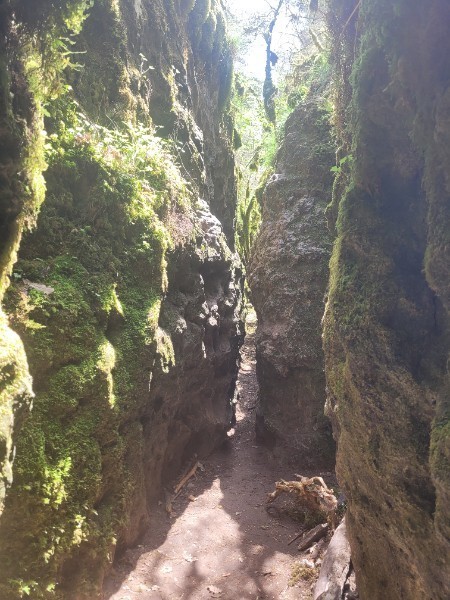
Through the Causse forest, this family-friendly hike takes you from caves to clearings, to discover natural fissures: the 'canoles'.
On the Larzac plateau, limestone erosion has not only sculpted ruiniform chaos: it has also carved out the 'canoles', narrow rock incisions whose walls are abundantly covered in moss and ferns. True pockets of coolness within their forest setting. Along the way, a detour to the Grotte de la Sébillère is a must.
The 'canoles' are rectilinear parallel corridors between steep walls, of varying width, opening into wider depressions. They were carved by limestone erosion, and their floor is formed by corrosion weathering products, the sandy 'grésou'. They should be likened to diaclases, rather than faults, as they are not displaced by subsidence.
Archaeological excavations carried out in the Canalettes rock shelter have revealed occupation of the area in prehistoric times (70,000-80,000 years ago), and the configuration of these fissures allowed for trapping diverse game.