Hiking - Tour de Niault
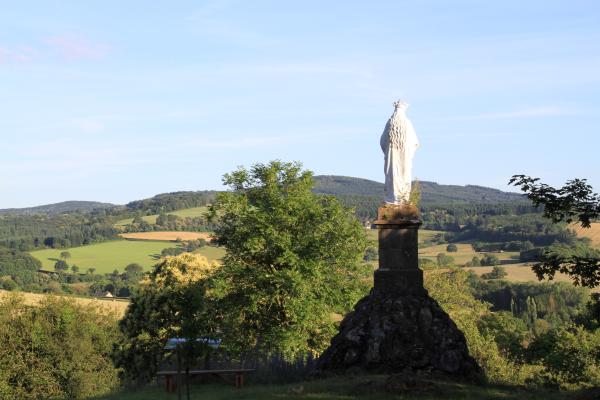
A trail rich in viewpoints that will lead you to the Virgin Mary statue overlooking the village of Onlay.
The Yellow-bellied Toad.
This small toad, 4 to 5 cm long, with very warty skin, is easily recognized by its heart-shaped pupil, and even more strikingly by the yellow spots on a black background on its belly, a true identity card for each individual. The males' call, a plaintive 'hou hou hou', is emitted day and night. The Yellow-bellied Toad frequents springs and the banks of some small streams in hilly hedgerow landscapes and ruts in lowland forests. It hibernates from October to March, in crevices, under stones, roots, or small mammal burrows. Its diet consists of earthworms, insects, and small terrestrial and aquatic mollusks. The southern Morvan is home to a nationally remarkable population, as the species is uncommon, or even threatened, in France. A network of small wetlands connected by terrestrial habitats is favorable for the toad's spawning and movements. Extensive farming practices are essential for its survival, and the species has benefited from the creation of three large Natura 2000 sites in Burgundy.
The Yellow-bellied Toad.
This small toad, 4 to 5 cm long, with very warty skin, is easily recognized by its heart-shaped pupil, and even more strikingly by the yellow spots on a black background on its belly, a true identity card for each individual. The males' call, a plaintive 'hou hou hou', is emitted day and night. The Yellow-bellied Toad frequents springs and the banks of some small streams in hilly hedgerow landscapes and ruts in lowland forests. It hibernates from October to March, in crevices, under stones, roots, or small mammal burrows. Its diet consists of earthworms, insects, and small terrestrial and aquatic mollusks. The southern Morvan is home to a nationally remarkable population, as the species is uncommon, or even threatened, in France. A network of small wetlands connected by terrestrial habitats is favorable for the toad's spawning and movements. Extensive farming practices are essential for its survival, and the species has benefited from the creation of three large Natura 2000 sites in Burgundy.